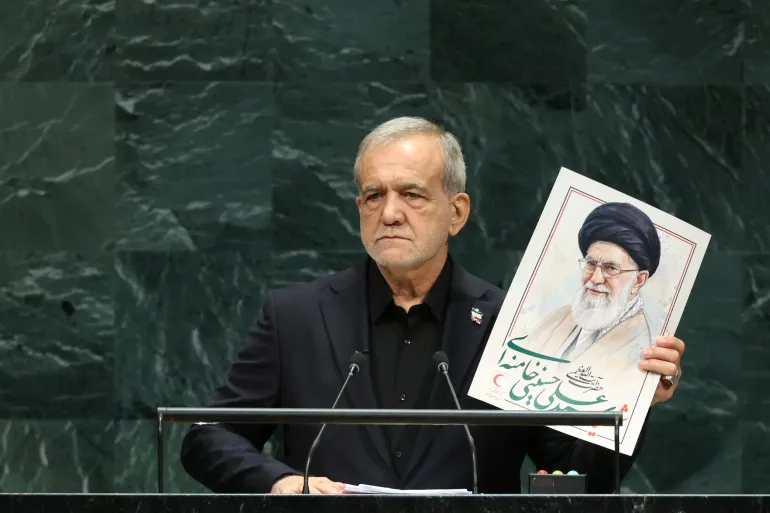
Iranian President Masoud Pezeshkian delivered a forceful speech at the United Nations General Assembly on Wednesday, accusing the United States of aggression and condemning what he described as international double standards toward Iran.
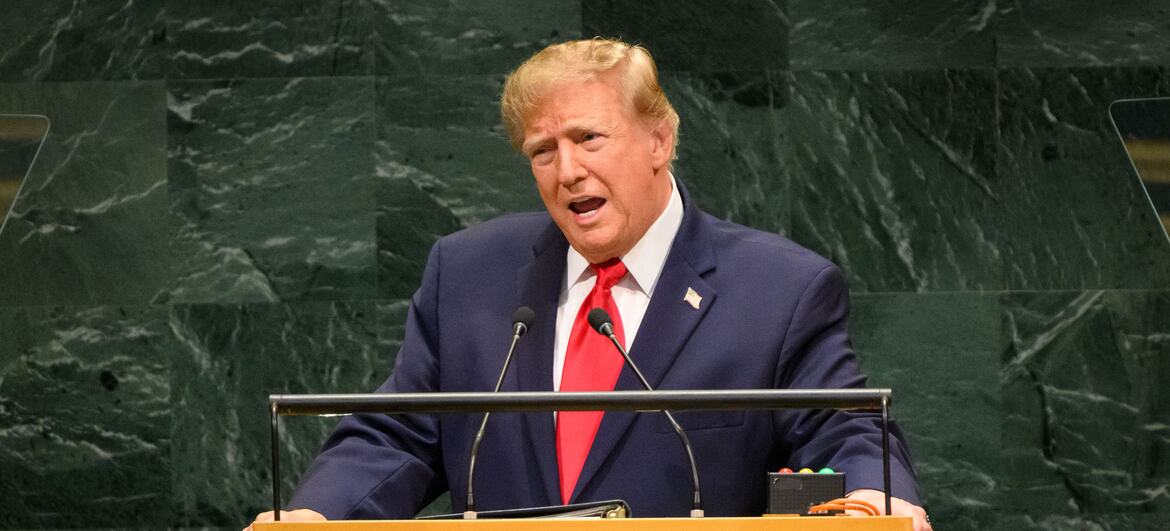
Pezeshkian’s remarks came one day after US President Donald Trump used the same UN platform to warn that the United States could “annihilate” Iran if an agreement could not be reached.
“The US president called us terrorists, but we are the victims of terrorists,” Pezeshkian said during his address.
The Iranian president displayed a photograph of former Supreme Leader Ayatollah Ali Khamenei, whom Iranian authorities say was killed in a joint US-Israeli strike at the beginning of the conflict in February. He also showed photographs of schoolgirls who were killed in what Iran described as a US airstrike on a school in Minab, in southern Iran.
“They hit us, but we did not bow our heads or bend the knee,” Pezeshkian said.
As Pezeshkian began speaking, a member of the US delegation left the UN General Assembly hall. Israel’s delegation also did not attend the address.
Pezeshkian warned that continued sanctions and pressure would strengthen resistance inside Iran.
“The resistance of the Iranian people will only grow in the face of sanctions and increased pressure and bullying,” he said.
Iran Signals Openness to Negotiations
Despite his criticism of Washington, Pezeshkian emphasized that Iran remains willing to engage with the international community.
“Iran extends its hands towards the world,” he said, calling for cooperation based on the belief that security in the region cannot be achieved by one country acting alone.
His comments came as diplomatic efforts involving the United States and Iran continued.
Trump said Tuesday that his son-in-law Jared Kushner and US envoy Steve Witkoff had held a three-hour meeting with Iranian officials. Trump described the talks as productive and said there was significant momentum toward a possible agreement.
The US president has nevertheless continued to issue strong warnings toward Tehran, including during his UN speech.
Trump asked whether an agreement could allow Iran to rebuild or whether the United States would instead move to destroy the Islamic Republic.
Dispute Over the Strait of Hormuz
The Strait of Hormuz was another major issue addressed by Pezeshkian.
Iran has opposed US efforts to restrict its access to the strategic waterway, while Tehran has also used threats against shipping through the strait as part of its response to the conflict.
Pezeshkian said Iran would resist attempts to use the waterway as a means of expanding pressure on the country.
The Strait of Hormuz is a critical international shipping route through which a significant share of global energy supplies passes.
Iranian political analyst Negar Mortazavi, a senior fellow at the Center for International Policy, told Al Jazeera that Pezeshkian’s speech combined familiar criticism of the United States with signals that Tehran was looking for a possible diplomatic path out of the conflict.
According to Mortazavi, Iran has continued to leave the possibility of diplomacy open and could potentially show flexibility in negotiations.
Gaza and Claims of Double Standards
Pezeshkian also drew comparisons between the conflict in Iran and Israel’s military campaign in Gaza.
He argued that the international response to the wars demonstrated what he called “double standards” toward Iran.
“They kill and we are sanctioned and we are punished,” Pezeshkian said.
The Iranian president’s comments reflect Tehran’s broader criticism of Western governments over their response to Israel’s actions in Gaza and their treatment of Iran.
Former US diplomat and ambassador to Tunisia Joey Hood, however, said the speech relied heavily on established Iranian government rhetoric and argued that it did not sufficiently pursue opportunities for compromise.
With negotiations continuing alongside military confrontation, Pezeshkian’s address combined a strong rejection of US pressure with an indication that Tehran remains willing to consider diplomacy.