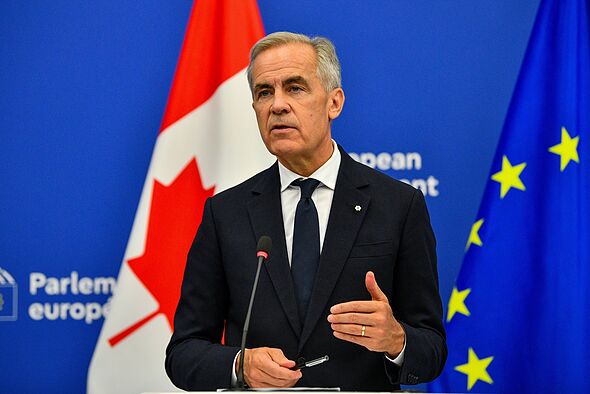
Canadian Prime Minister Mark Carney said his government has considered even the most extreme scenarios involving the United States, including the possibility of military action against Canada, as relations between the two longtime allies remain strained.
In an interview with The New York Times published Wednesday, Carney was asked about repeated statements by US President Donald Trump regarding Canada, including his previous proposal that the country become the 51st US state.
Carney said it would be irresponsible for a Canadian government not to examine low-probability scenarios with potentially severe consequences.
“I think you have a responsibility in these roles to look at extreme tail risk,” Carney said, describing the approach as risk management rather than an indication that such an outcome was expected.
The comments come amid an increasingly difficult economic relationship between Ottawa and Washington. Trade negotiations have deteriorated, while the two countries have imposed or threatened retaliatory tariffs.
Carney Says Communication With Trump Continues
Despite the tensions, Carney said he continues to communicate directly with Trump.
The Canadian prime minister described their relationship as one in which both leaders can speak directly about disagreements and policy issues.
Carney said the two have spoken several times since trade negotiations broke down and indicated that communication between their governments remains important despite their differences.
The comments suggest that Ottawa is attempting to maintain channels for negotiations while simultaneously preparing for a range of possible outcomes.
Canada Seeks to Reduce Dependence on the US
Carney has also increasingly emphasized the need for Canada to diversify its economic and strategic relationships.
In recent remarks, he said Canada's decades-long economic integration with the United States had created significant dependence on a single major partner. His government has therefore been pursuing stronger commercial relationships with Europe and Asia.
Canada has also been exploring alternatives in areas involving technology, defense and critical infrastructure. Recent reporting has highlighted Ottawa's efforts to reduce vulnerabilities created by dependence on US-linked systems and suppliers.
Canada's trade diversification efforts extend beyond Europe. Ottawa is pursuing deeper economic ties with Southeast Asia, with Canadian officials saying negotiations with the Philippines and the Association of Southeast Asian Nations were more than 90 percent complete as of September 22.
Trade Tensions Continue
The dispute with Washington remains centered largely on tariffs and the future structure of the US-Canada economic relationship.
Carney has argued that Canada can pursue diversification without abandoning the possibility of a mutually beneficial trade relationship with the United States.
The prime minister has also promoted closer cooperation between Canada and the European Union. Reuters reported that Carney has proposed an alliance focused on strengthening resilience in areas including energy, technology, critical minerals and financial systems.
While tensions between Ottawa and Washington have intensified, Carney's comments indicate that Canada is pursuing two approaches simultaneously: maintaining direct dialogue with the United States while preparing for a broader range of economic and security scenarios.
For now, Carney has characterized the possibility of a US military attack as an extreme contingency rather than the expected course of events.