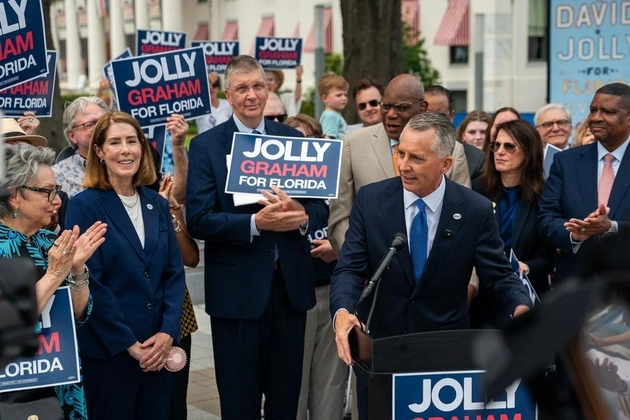
MIAMI — As Democratic candidates across the country embrace anti-establishment messages and more confrontational campaign styles, Florida Democrat David Jolly is taking a notably different approach.
Jolly, a former Republican congressman who later became an independent before joining the Democratic Party, is running for governor with a message centered on civility, affordability and governing rather than political confrontation.
The former attorney and political commentator has repeatedly said he does not intend to run a negative campaign. He has argued that many Florida voters are looking for a different tone in politics after years of increasingly bitter partisan battles.
“I think it’s a 1974 post-Watergate moment, where people are looking for something better,” Jolly told POLITICO, comparing the current political climate to the period following the Watergate scandal.
He said voters are dealing with concerns about the economy, housing, health care and government corruption and that his campaign is attempting to address those issues without intensifying political divisions.
A different Democratic approach
Jolly's political history sets him apart from many Democratic candidates.
He served as a Republican member of the US House before leaving the party and becoming an independent in 2018, citing disagreements with Donald Trump. He joined the Democratic Party more recently and secured the Democratic nomination for governor in August.
Former Democratic Gov. Jerry Demings withdrew from the primary after announcing a prostate cancer diagnosis, while state Rep. Dotie Joseph entered the race late. Jolly ultimately won the Democratic primary with 61% of the vote.
Jolly selected former US Rep. Gwen Graham as his running mate. Graham, the daughter of former Florida Gov. and US Sen. Bob Graham, previously ran for governor in 2018, when Andrew Gillum won the Democratic nomination before narrowly losing the general election to Ron DeSantis.
Jolly has described Graham as a close friend and someone he expects to be an active governing partner.
Republicans take a different view
Jolly's Republican opponent, US Rep. Byron Donalds, has sought to portray the Democratic ticket as more ideologically aligned with the national Democratic Party than Jolly's campaign suggests.
Donalds won the Republican primary in August and selected state Sen. Bryan Ávila as his running mate.
Republican criticism has focused in part on Jolly's moderate presentation and his decision to avoid making Trump the central issue of his campaign.
Donalds has argued that Jolly's relatively restrained style is a deliberate strategy intended to make Democratic candidates more acceptable to Florida voters.
The two campaigns are now preparing for a series of debates. Both candidates have said they expect debates to take place before Election Day, although their campaigns have been working out the details of the formats and schedules. Jolly has said he prefers debates focused on substantive questions rather than events designed primarily for political spectacle.
Florida presents a different political environment
Florida has become substantially more Republican over the past decade, making the state's political landscape different from that of many other states where Democratic candidates have recently benefited from anti-establishment campaigns.
Jolly's strategy is therefore built around reaching voters who may not consistently support one party.
He has argued that economic concerns, particularly the cost of housing and other household expenses, could create an opening for Democrats among voters who do not normally vote for the party.
Recent elections and political contests have also highlighted the importance of independent and non-party voters in Florida.
Questions about the Democratic coalition
Jolly's approach has not been without criticism from within Democratic circles.
Some Democrats have argued that the party needs a more aggressive response to Republican policies, particularly on health care, food assistance and other issues affecting lower-income communities.
State Rep. Angie Nixon, who is running for the Democratic nomination for the US Senate, has argued that Democrats need candidates willing to confront Republicans more directly.
Other Democratic figures have emphasized the importance of reducing political hostility and focusing on concrete problems facing Floridians.
The debate reflects a broader question for Florida Democrats: whether voters are more responsive to an explicitly combative campaign or to a message centered on practical issues and a less confrontational political style.
Jolly and Graham defend their approach
Jolly has said his campaign's tone should not be confused with a lack of urgency.
He acknowledged that some Democratic supporters previously encouraged him to attack Trump more aggressively and present himself as a stronger political fighter.
At one point during the campaign, he said, he became more openly emotional while discussing housing, health care, education and immigration.
“What happened is this campaign became one that lives with urgency,” Jolly said. “That’s different than anger.”
Graham has similarly argued that many voters are exhausted by the increasingly negative tone of American politics.
“I do think that there’s an exhaustion with what’s been going on with our politics, with the negativity,” she said.
A closely watched general election
The general election will feature Jolly and Donalds as the major-party nominees, alongside candidates from outside the two major parties.
Recent polling has produced closely divided results. A St. Pete Polls survey conducted September 15-17 among 913 likely voters found Donalds at 44% and Jolly at 43%, with a margin of error of plus or minus 3.2 percentage points. The survey's methodology included weighting by party affiliation, race, age, gender and media market.
Campaign finances show a substantial difference between the candidates. As of September 11, Donalds and his political committee had nearly $44 million in cash on hand, while Jolly's campaign and political committee together held roughly $6.3 million.
The race is also attracting national attention, with House Democratic Leader Hakeem Jeffries endorsing Jolly and Graham in September.
With the primary contests finished, the campaign is now focused on the November 3 general election, with both candidates seeking to define what kind of political leadership Florida voters want after years of Republican control of the governor's office.